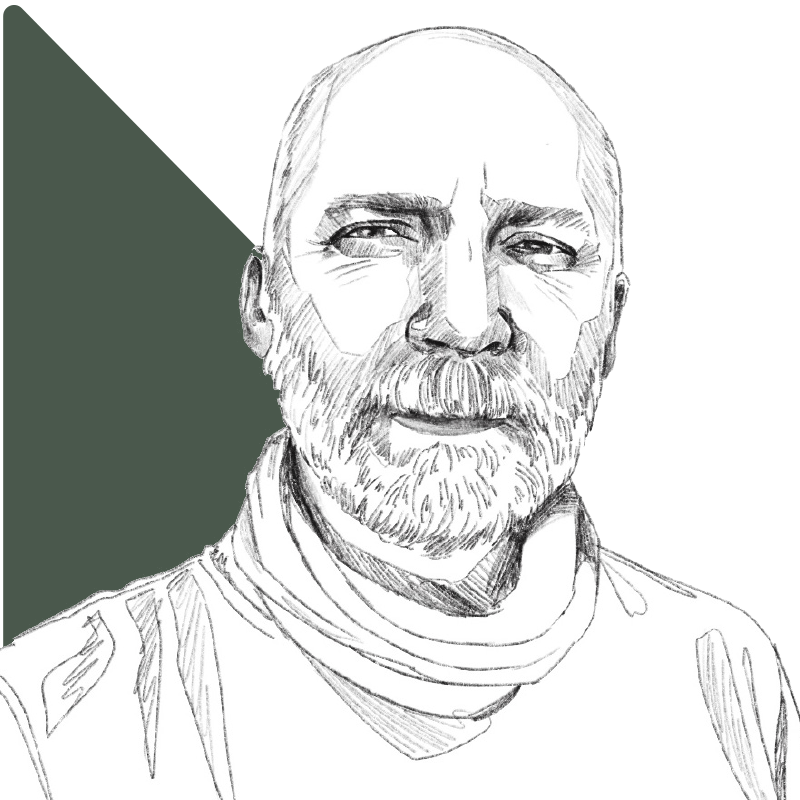
The mathematician of art and creativity
Marcus du Sautoy is a British mathematician and science communicator who explores how mathematical ideas shape music, art, games, technology and human creativity. His work shows that mathematics is not simply a collection of rules and calculations, but a language for finding patterns, testing possibilities and understanding the structures hidden beneath everyday experience.
As Simonyi Professor for the Public Understanding of Science at the University of Oxford, du Sautoy has brought advanced mathematics to large audiences through books, television, radio, theatre and collaborations with artists. He is particularly interested in the frontier between human and machine creativity and in the question of whether artificial intelligence can produce work that is genuinely original.
His books include The Creativity Code, Better Thinking, Around the World in 80 Games and Blueprints: How Mathematics Shapes Creativity. Through examples drawn from literature, painting, performance and play, he explains how shortcuts, symmetry, uncertainty and formal systems influence the way people invent and solve problems. He also works with cultural organisations, from the Royal Opera House to the Glastonbury Festival, to make scientific ideas vivid and accessible.
Career and recognitions
Du Sautoy is Professor of Mathematics at the University of Oxford and a Fellow of New College. He has presented major BBC series including The Story of Maths and The Code, as well as programmes with comedians Alan Davies and Dara O’Briain. He has also written and performed the plays I is a Strange Loop and The Axiom of Choice, using theatre to investigate identity, free will and mathematical logic.
He was elected a Fellow of the Royal Society in 2016. In 2009 he received the Royal Society’s Faraday Prize, the United Kingdom’s leading award for excellence in communicating science, and in 2010 he was appointed an Officer of the Order of the British Empire for services to science. He has also advised the British government on the impact of artificial intelligence and regularly speaks about the opportunities and responsibilities created by emerging technologies.