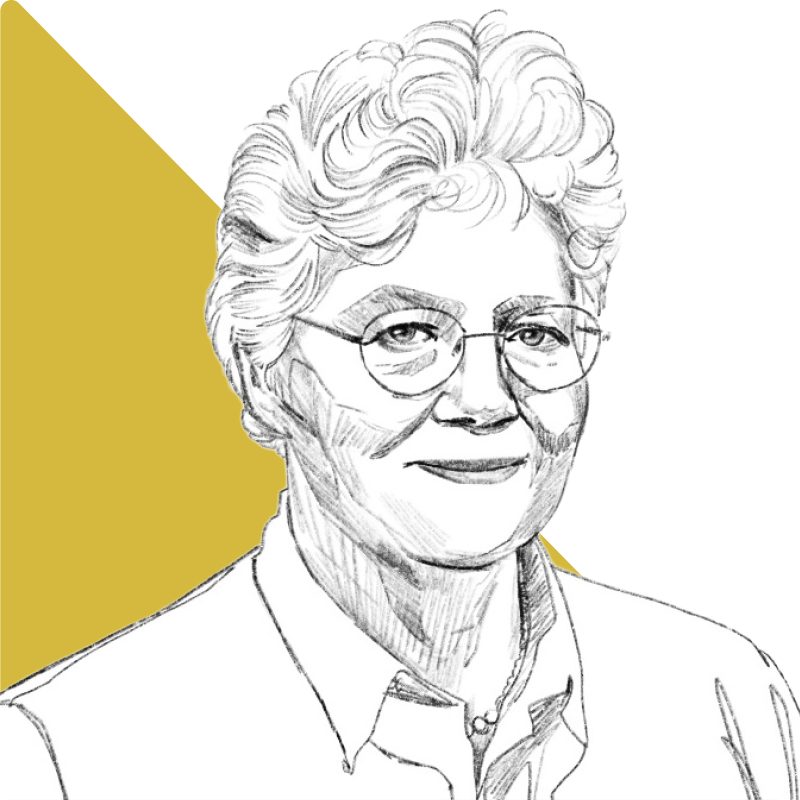
The first to film the dance of electrons
Anne L’Huillier was awarded the 2023 Nobel Prize in Physics, jointly with Pierre Agostini and Ferenc Krausz, for the development of experimental methods that generate attosecond pulses of light to study the dynamics of electrons in matter. This French-Swedish physicist is one of the founders of attosecond science, a field that makes it possible to observe the motion of electrons inside atoms and molecules. An attosecond (10⁻¹⁸ seconds) is an almost unimaginably short interval of time: one billionth of a billionth of a second. By creating flashes of light on this scale, scientists can follow processes that were previously too fast to be measured.
Her research focuses on high-order harmonic generation in gases. When intense laser light interacts with atoms, it can produce a series of very high frequencies that can be combined into extremely short pulses. L’Huillier helped explain this phenomenon and turn it into a reliable experimental method, opening a new window onto the dynamics of matter.
These tools allow researchers to investigate how electrons move, how chemical bonds begin to change and how electronic processes influence the behaviour of materials. Attosecond physics is therefore important not only for fundamental science, but also for future developments in electronics, photonics, chemistry and the control of quantum systems.
Career and recognitions
L’Huillier began her career at the Commissariat à l’Énergie Atomique in Saclay, France, first as a doctoral student and later as a permanent researcher. She completed her PhD in 1986 and carried out postdoctoral work at Chalmers University of Technology in Gothenburg and at the University of Southern California. She was also a visiting scientist at Lawrence Livermore National Laboratory.
In 1995 she moved to Lund University in Sweden, where she became a full professor in 1997 and established an internationally recognised research group. The 2023 Nobel Prize in Physics, which she received jointly with Pierre Agostini and Ferenc Krausz, recognized this body of research, which transformed an abstract timescale into a practical tool for observing the microscopic world.