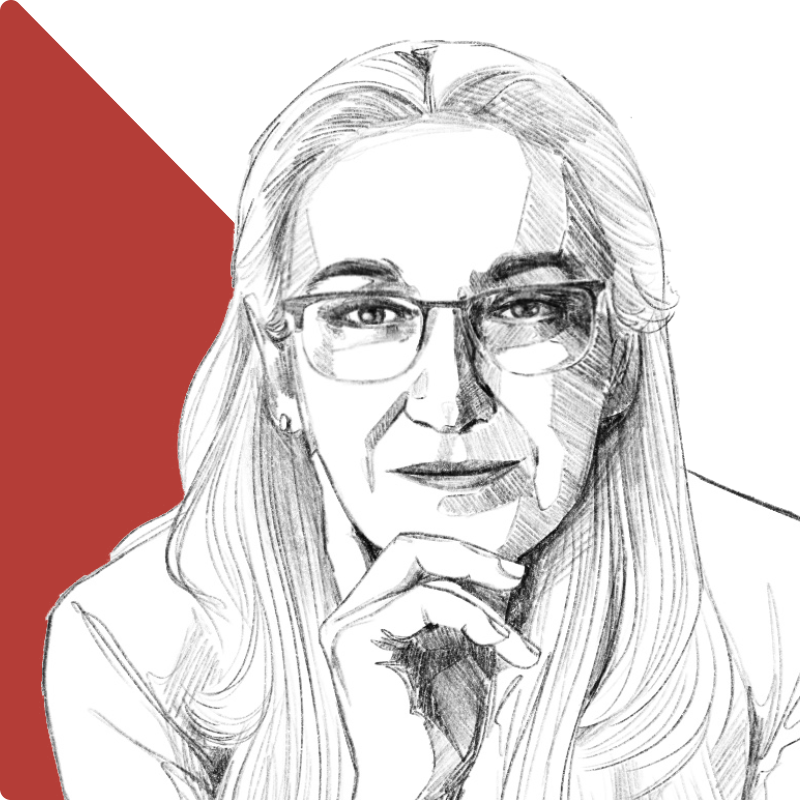
The photographer of cell division and gene expression
Eva Nogales is a physicist and structural biologist whose research allows scientists to see the molecular machines that organise and regulate living cells. Her laboratory uses cryo-electron microscopy, computational analysis, biochemistry, and biophysics to visualize large biological complexes in three dimensions and in different functional states in order to understand how they work.
One of her earliest major contributions was to determine the atomic structure of tubulin, the protein from which microtubules are built. Microtubules form part of the cellular skeleton, organise the inside of the cell, provide routes for molecular transport, and form the spindle that separates chromosomes during cell division. Understanding tubulin’s structure clarified how microtubules assemble and how medicines that alter their dynamics can act against diseases such as cancer.
Nogales’s research also examines the machinery that controls gene expression in eukaryotic cells. Her team has visualised large transcription complexes, including TFIID, RNA polymerase II and other factors required to begin the transcription of DNA. By comparing these structures in different configurations, researchers can move beyond static images and explain how genes are selected, activated and regulated.
Career and recognitions
Born in Colmenar Viejo, Madrid, Nogales studied Physics at the Autonomous University of Madrid and completed her doctorate at Keele University in the United Kingdom. She carried out postdoctoral research at Lawrence Berkeley National Laboratory with Kenneth Downing, specialising in electron microscopy and image analysis. In 1998 she joined the University of California, Berkeley, and since 2000 she has been an investigator of the Howard Hughes Medical Institute.
Nogales is a member of the National Academy of Sciences of the USA and the American Academy of Arts & Sciences, and foreign member of EMBO and of the Real Academia de Ciencias de España and the Royal Society of London. In 2023 she received the Shaw Prize in Life Science and Medicine for visualising at atomic resolution the protein machinery responsible for gene transcription. Her work has had broad impact on cell biology, genetics, cancer research and pharmacology.